My Sustainable City: London, UK Part 1
Patrick Nielsen
College of Architecture and Planning, Department of Urban and Regional Planning
UPRL: 5040 – 001: Urban Sustainability
Priyanka deSounza, PhD, MSc, MBA, MTech
January 26, 2026
Overview
London’s current population is approximately 8.9M residents. Since the 1960s, London has had an overall positive growth rate; however, in around 1980 there was a dip in the population which decreased to 6.7M from the previous decade, 1970, 7.5M. Several interrelated factors contributed to this decrease, including economic restructuring, high levels of pollution, deteriorating housing conditions, and broader urban challenges affecting quality of life. With all of these factors combined it forced Londoners to transport to other nearby cities/suburban areas which grew London even more over time. After the 1980’s the population grew to 9.9M. This growth is due to large transportation capabilities for travel, better economic growth, and overall better housing. The projections for the next decade in London are as follows: (2030, 10.2M), (2035, 10.6M)
Throughout history, London has become a huge shipping region for that part of the world. When the city was growing in the 1900s, it had about 35 miles of docking areas that had riverside moorings, wharfage, shipyards, and heavy industry along the banks of many different rivers in London. Around the 1970s, these shipping yards has become more consolidated just to the Thames estuary.
Along with shipping, manufacturing became big in the 18th and 19th centuries; London produced luxury items such as
silks, fine furniture, gilded work, watches, musical instruments, millinery, and women’s clothing. With electricity
running in the new 20th century electricity became London’s new powerhouse industry. Many of these manufacturers
were in the Thames River area. This helped London to easily ship to 1000 other ports around the country and the
world, massively growing the economy of London (More than £1.1 Billion Investment to Boost Growth, Jobs and Skills
in UK’s Coastal Towns and Cities - GOV.UK, n.d.)5 Environmental Problems in London | Earth.Org. (n.d.). Retrieved
March 15, 2026, from https://earth.org/environmental-problems-in-london/
Christie, E., & Douglass, G. (n.d.). London and Europe: Facts and figures.
London Gateway Posts Strong Growth and Is Poised to Be UK’s Largest Port. (n.d.). Retrieved March 15, 2026, from
https://maritime-executive.com/article/london-gateway-posts-strong-growth-and-is-poised-to-be-uk-s-largest-port
More than £1.1 billion investment to boost growth, jobs and skills in UK’s coastal towns and cities—GOV.UK. (n.d.).
Retrieved March 15, 2026, from https://www.gov.uk/government/news/more-than-11-billion-investment-to-boost-
growth-jobs-and-skills-in-uks-coastal-towns-and-cities
Waste and recycling | London City Hall. (n.d.). Retrieved March 15, 2026, from https://www.london.gov.uk/programmes-
strategies/environment-and-climate-change/waste-and-recycling.
Today, London is a major hub in the modern world. The employment sector is vast, and had major contributions changes each year. As of 2013, financial and insurance activities, the arts entertainment and recreation, public administration and education, high value business support, travel and tourism are the top 5 major industry/economic activities within London (Christie & Douglass, n.d.). London is located in the UK which is a part of Europe.
London has the Greater London Authority, which is led by the Mayor of London, who acts as the strategic regional planning authority for London. The Mayor’s Planning Team develops the London Plan, which serves as the statutory spatial development strategy, guiding development across the 32 different London boroughs and the City of London.
Environmental Planning Context
Air pollution is one of the most pressing environmental problems in London. With London having high traffic and vehicles on the road, London also has the Tube which has the most polluted part of the city. Particulates of dust and metal build up which are also called PM2.5 particulate matter. This material leads to a wide range of harmful health conditions related to heart disease, stroke, lung cancer, and other respiratory infections.
Because London is the largest city in the UK more than 18 million metric tons of waste is produced (5 Environmental Problems in London | Earth.Org, n.d.). This would be from the construction industry, commercial industry, household waste and more. Recycling is a part of London’s wastes’ benefactors; however, because it is only at 32% usage it is not enough to mitigate London’s overall waste usage. When the overall sorting of the city’s trash is sorted, it is then burned and used as electricity. By 2030, London hopes to recycle 65% of its municipal waste (Waste and Recycling | London City Hall, n.d.).
Another environmental issue in London is flooding. The city is surrounded by five sources of flooding: tidal, fluvial (rivers and tributaries), surface, sewer, and groundwater flooding. Due to climate change the city has become a hot spot for wetter winters and heavier rains that would cause the sea level to rise which includes the Thames River and more bodies of water. London also lacks proper drainage throughout the city including green spaces.
Sustainability Planning Context
London has several different documents that are sustainability based. The London Plan emphasizes “Good Growth” which induces policies for reducing carbon emissions, increasing green infrastructure, and optimizing sustainable transport. Planning for Sustainability was adopted to enforce standards for retrofitting, energy use, circular economy, climate resilience, and urban greening. Sustainable Design and Construction is another one that provides guidance on implementing London Plan policies regarding energy efficient design, carbon reduction, and renewable energy. London Sustainable Drainage Action Plan focuses on accelerating the delivery of Sustainable Drainage Systems to improve flood resilience. Finally Emerging City Plan 2040 sets the long-term vision for sustainable development within the City of London.
References
The Construction Specifications Institute. (2016, December 14). Sustainable Design and Construction. London City Hall. https://www.london.gov.uk/programmes-strategies/planning/implementing-london-plan/london-plan-guidance-and-spgs/sustainable-design-and
The Greater London Authority. (2024, November 4). The London Plan 2021. London City Hall. https://www.london.gov.uk/programmes-strategies/planning/london-plan/london-plan-2021
Happold, B. (2025, February). Planning for Sustainability SPD. Planning for Sustainability . https://www.cityoflondon.gov.uk/assets/Services-Environment/Planning-for-Sustainability-SPD.pdf
Hebbert, M. J. (2026, January 30). London - Finance, economy, global hub | Britannica. Britannica. https://www.britannica.com/place/London/Finance
Johnson, B., & Khan, S. (2016). London Sustainable Drainage Action Plan Draft for public consultation. London Sustainable Drainage Action Plan. https://www.london.gov.uk/sites/default/files/lsdap_final.pdf
Planning. London City Hall. (2026, January 29). https://www.london.gov.uk/programmes-strategies/planning#:~:text=The%20Mayor%20of%20London’s%20Planning%20Team%20prepares,planning%20bodies%2C%20including%20government%20and%20London%20boroughs
McNicol, Rob (n.d.). City plan 2040. City Plan 2040 Shaping the Future City. https://www.cityoflondon.gov.uk/assets/Services-Environment/City-Plan-2040.pdf
Shukla, Nikita (2024, April 16).5 environmental problems in London. Earth.Org. https://earth.org/environmental-problems-in-london/#:~:text=London%20faces%20many%20environmental%20challenges%2C%20including:%20*,change%20*%20Rising%20temperatures%20*%20Population%20growth
Tony Champion and Peter Congdon, (1989), An Analysis of the Recovery of London’s Population Change Rate Vol. 13, No. 4, https://www-jstor-org.aurarialibrary.idm.oclc.org/stable/23286200?seq=1
Wingham, M., & Hope, M. (2019). Transforming the supply and use tables into input-output tables. Studies in Methods (Ser. F), 369–410. https://doi.org/10.18356/9789213582794c020
World Population Review. (2026, January 19). London population 2026. https://worldpopulationreview.com/cities/united-kingdom/london
Fig. 1 Map showing the River Thames This figure was uploaded by Roger A. Falconer Author of Source: Binliang Lin and Roger A. Falconer Source was with article: Integrated 1-D and 2-D Models for Flows and Water Quality Modelling
Source: IQAir Earth Air Pollution Map March 23, 2026 2:00 MT
My Sustainable City: London, UK Part 2 Water Supply
Patrick Nielsen
College of Architecture and Planning, Department of Urban and Regional Planning
UPRL: 5040 – 001: Urban Sustainability
Priyanka deSounza, PhD, MSc, MBA, MTech
March 1, 2026
Agency Responsibility for Water Supply
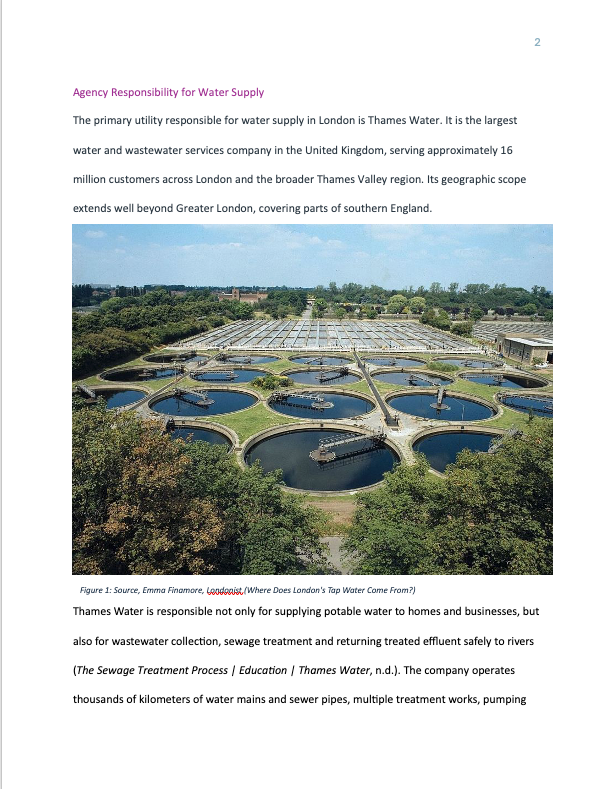
The primary utility responsible for water supply in London is Thames Water. It is the largest water and wastewater services company in the United Kingdom, serving approximately 16 million customers across London and the broader Thames Valley region. Its geographic scope extends well beyond Greater London, covering parts of southern England.
Thames Water is responsible not only for supplying potable water to homes and businesses, but also for wastewater collection, sewage treatment and returning treated effluent safely to rivers (The Sewage Treatment Process | Education | Thames Water, n.d.). The company operates thousands of kilometers of water mains and sewer pipes, multiple treatment works, pumping stations, and reservoirs. Unlike municipally operated systems common in the United States, Thames Water is a privatized unity regulated by the UK government (In the Public Interest, 2023). It is overseen by Ofwat (the Water Services Regulation Authority), which regulates pricing and performance standards (Home - Ofwat, n.d.). Funding comes primarily from customer water bills, along with private investments and debt financing to support infrastructure improvements.
Primary Sources of Fresh Water and Infrastructure
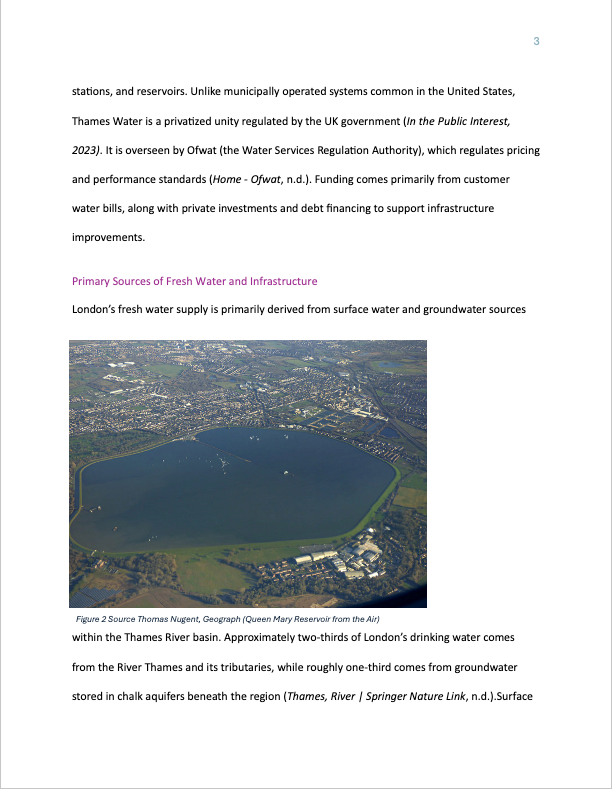
London’s fresh water supply is primarily derived from surface water and groundwater sources within the Thames River basin. Approximately two-thirds of London’s drinking water comes from the River Thames and its tributaries, while roughly one-third comes from groundwater stored in chalk aquifers beneath the region (Thames, River | Springer Nature Link, n.d.).
Surface water from the River Thames and River Lee is abstracted and conveyed to large treatment facilities. Major storage infrastructure includes the Queen Mary Reservoir and the Wraysbury Reservoir, which store raw water before treatment. Water is treated through multiple stages: screening, sedimentation, filtration, and disinfection (typically using ozone or ultraviolent treatment followed by chlorination) to ensure safety and compliance with drinking water standards (How Water Treatment Works | Drinking Water | CDC, n.d.). After treatment, water is pumped through an extensive distribution network to households and businesses.
London also supplements its supply through water recycling and during periods of drought risk has access to desalination via the Beckton Desalination Plant (The Sewage Treatment Process | Education | Thames Water, n.d.). This plant, located in East London, can treat brackish water from the Thames estuary and provide up to 150 million liters per day during severe shortages. Although used sparingly due to cost and energy intensity, it serves as a strategic resilience asset. Fresh Water in Major Planning Documents
Fresh water supply is prominently addressed in the London Plan, which serves as the spatial development strategy for Greater London (Towards a New London Plan - Consultation | London City Hall, n.d.). The London Plan emphasizes water efficiency, sustainable drainage systems (SuDS), and integrated water management. It requires new developments to meet stringent water consumption targets (currently 105 liters per person per day or lower) and encourages grey water recycling and rainwater harvesting (Policy 5.15 Water Use and Supplies | London City Hall, n.d.).
Additionally, Thames Water’s Water Resources Management Plan (WRMP) outlines long-term strategies to balance supply and demand through leakage reduction, demand management, smart metering, new reservoirs, and potential inter-basin water transfers (Latest News - Thames Water Resources Management Plan, n.d.). Water considerations are also integrated into climate adaptation and resilience planning documents, recognizing the growing stress on regional supplies.
Major Threats and Policy Responses
London faces several significant threats to its fresh water supply:
1. Climate Change and Drought: Rising temperatures and shifting precipitation patterns increase the likelihood of prolonged droughts. The Thames basin is already classified as water stressed.
2. Population Growth: London’s expanding population increase per capita water demand.
3. Aging Infrastructure and Leakage: London’s historic pope network contributes to substantial water loss through leaks.
4. Water Quality Risks: Urban runoff, agricultural pollution upstream, and wastewater discharges can degrade source water quality.
To address these treats, London and Thames Water have implemented multiple strategies. Leakage reduction is a major focus, with ambitious targets to cut losses by 50% by 2050 (Thames Water Pipe Leaks at Highest Level in Five Years, FoI Reveals | Water | The Guardian, n.d.). Universal smart metering is being expanded to encourage conservation through real-time usage feedback. The proposed South East Strategic Reservoir Option (SESRO) would provide additional storage capacity in Oxfordshire to enhance drought resilience.
Policy tools also include stricter building codes, water efficiency standards, watershed protection efforts, and expanded sustainable drainage systems to reduce runoff and improve aquifer recharge. Collectively, these strategies aim to transition London toward a more resilient and water-secure future.
References
Home—Ofwat. (n.d.). Retrieved March 1, 2026, from https://www.ofwat.gov.uk/
How Water Treatment Works | Drinking Water | CDC. (n.d.). Retrieved March 1, 2026, from https://www.cdc.gov/drinking-water/about/how-water-treatment-works.html
Latest news—Thames Water Resources Management Plan. (n.d.). Retrieved March 1, 2026, from https://thames-sro.co.uk/news/keeping-water-flowing-for-the-future-thames-water-publishes-its-water-resources-management-plan/
Policy 5.15 Water use and supplies | London City Hall. (n.d.). Retrieved March 1, 2026, from https://www.london.gov.uk/programmes-strategies/planning/london-plan/past-versions-and-alterations-london-plan/london-plan-2016/london-plan-chapter-five-londons-response/pol-14
Thames, river | Springer Nature Link. (n.d.). Retrieved March 1, 2026, from https://link.springer.com/rwe/10.1007/1-4020-4497-6_218
Thames Water and the Ownership of Utilities. (n.d.). Retrieved March 1, 2026, from https://inthepublicinterest.org/thames-water-and-the-ownership-of-utilities/
The sewage treatment process | Education | Thames Water. (n.d.). Retrieved March 1, 2026, from https://www.thameswater.co.uk/about-us/community/education/the-sewage-treatment-process
Towards a new London Plan—Consultation | London City Hall. (n.d.). Retrieved March 1, 2026, from https://www.london.gov.uk/programmes-strategies/planning/london-plan/towards-new-london-plan-consultation